People are the engine. Kopling is the clutch: community software that engages the energy people already bring — sharing the moment while it's still a moment, welcoming the very first post, keeping every conversation whole — so interaction can grow into honest, real connection.
In development · by whom?
36 hours of labor and worth every second — welcome to the world, little one. Mom and baby both doing great.
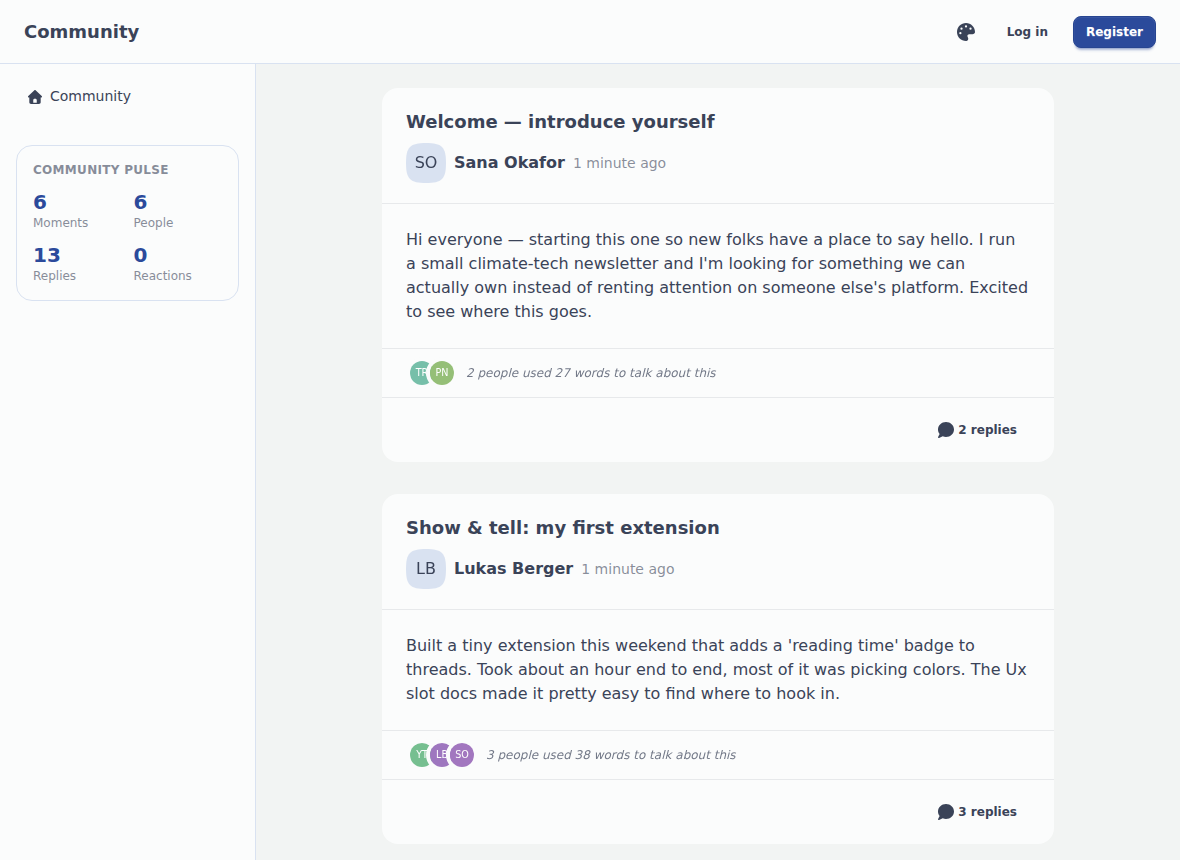
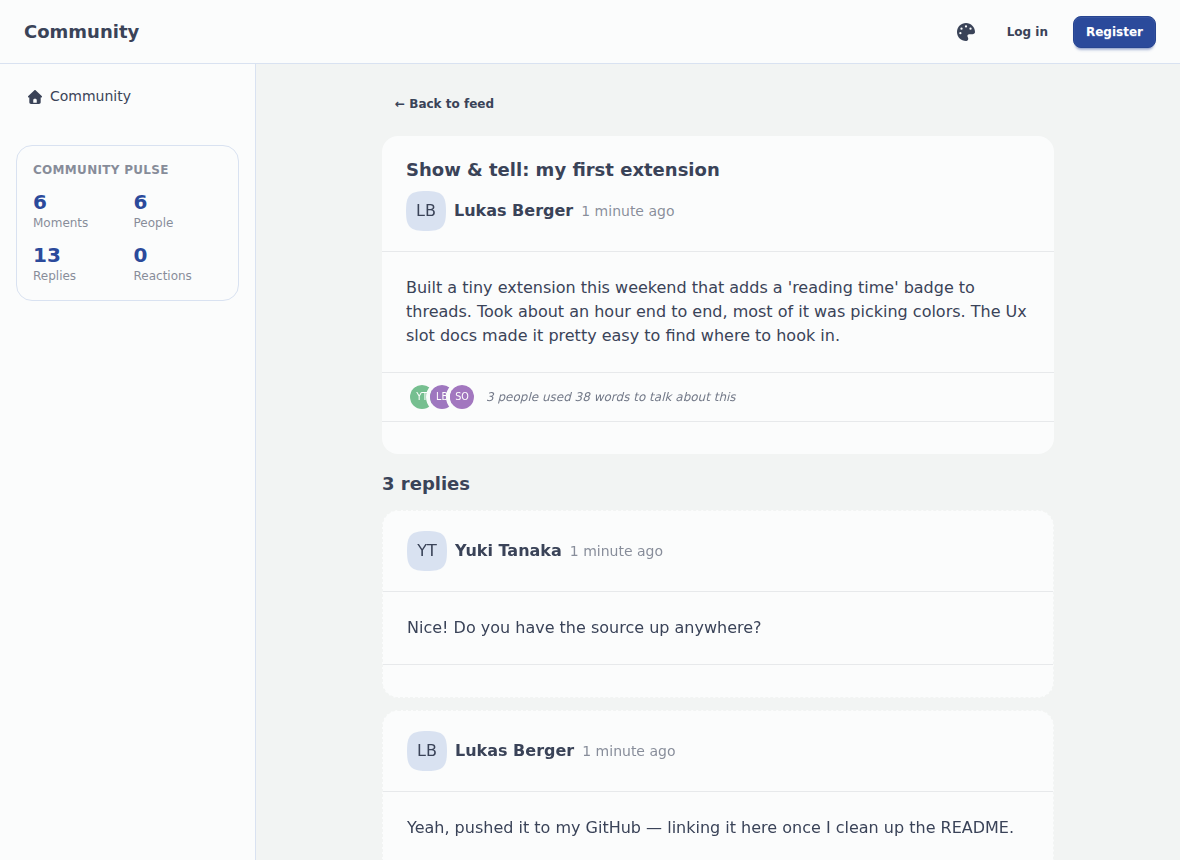
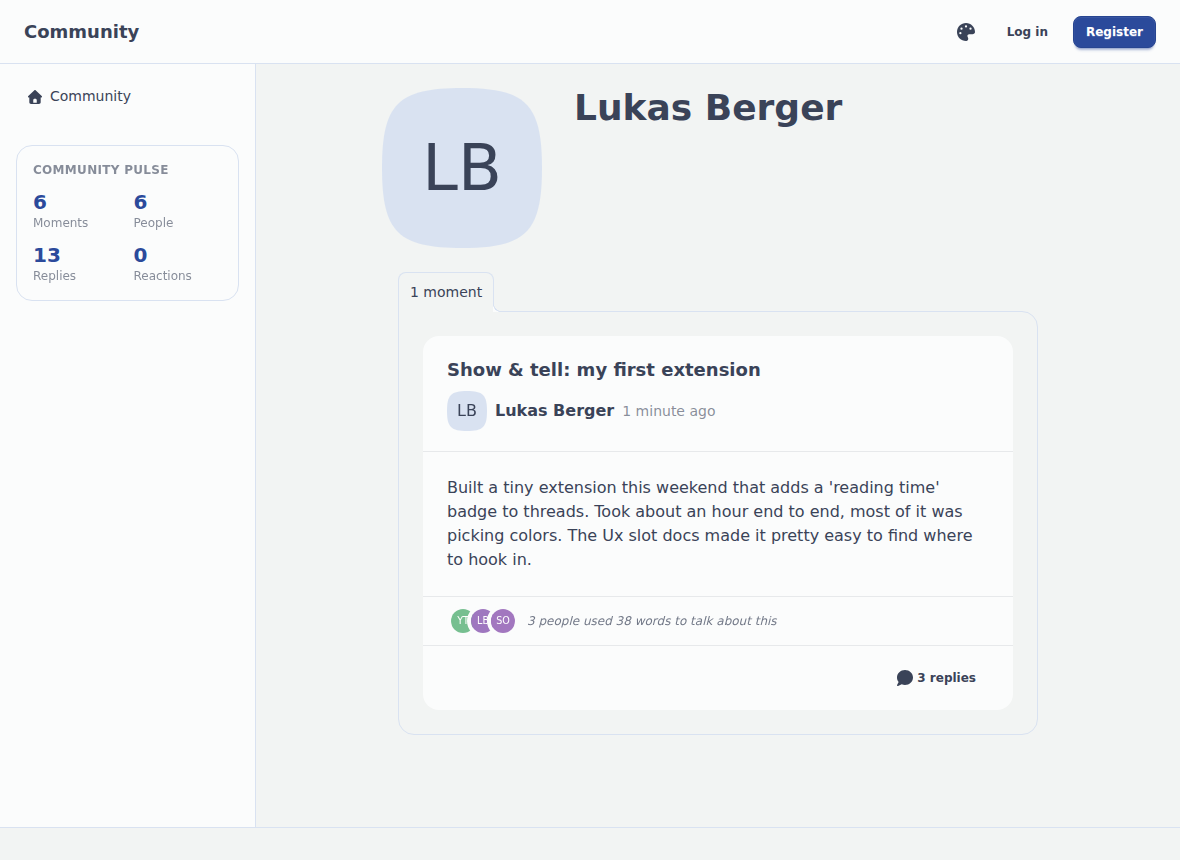
A real Moment on a Kopling community — one post, its replies and reactions gathered as one whole thing, updating live.
Kopling exists so human interaction can grow into honest, real relationships — through work, hobbies, friendship, or a stranger's well-intended answer at the right moment.
That's why we build for people, not "users". People have real emotions, struggles, and hopes — good days and bad ones. Engagement is what happens when people enjoy each other; it's a consequence we welcome, never a metric we optimize.
Kopling is open source software you install on your own server to run a community — the same role a forum has played for decades, rebuilt for how people actually talk online today. What people share is called a Moment: the post and everything that gathers around it — every reply, every reaction — as one whole thing, never a first post buried inside a separate thread. Nothing here is a chat app or a social feed you don't control.
A Moment holds the whole thing — what's shared, plus every reply and reaction around it — so nothing's scattered across a feed or split off into a separate "original post."
No refresh button. Reactions and reply counts update the moment someone responds — like the demo above.
A quick "this is cool" counts as a real response — warmth doesn't require writing an essay.
A Kopling community can talk to other Kopling sites — and to Mastodon and the wider fediverse — so a Moment isn't trapped behind one site's login.
Install it on your own server or hosting, own your community's data, and shape it with extensions — no platform can shut it down or change the rules on you.
Fast on a weak connection, installable like an app, with real push notifications — not a desktop tool squeezed onto a small screen.
Connection is the goal; everything below is in service of it. These aren't features on a roadmap — they're constraints every technical decision on this page was tested against.
Free license, public development, and a governance model designed before the community arrives — not after.
Discussions federate as discussions — threaded, forum-shaped — over ActivityPub, following the trail Discourse and NodeBB blazed.
Server-rendered pages that are fast on weak connections, installable as an app, with push notifications from day one.
A moment shared while it's still a moment is unpolished and honest. Replies stream in live, and a simple "this is cool" counts — warmth shouldn't require an essay.
Extensions are PHP and templates — no build step, no frontend framework to learn, no upgrade roulette.
Runs modestly on modest hosting, shines on real infrastructure — and tells you plainly which mode you're in.
Most projects announce a vision. We're publishing the engineering decisions — and the reasoning — so you know exactly what you'd be building on, contributing to, or sponsoring.
rev. 2026-07 — decisions are published before code so they can be challenged early. Disagree? That's what the discussion is for.
If you've ever built for a forum platform, you know the pain: a bespoke frontend framework, a mandatory build pipeline, and monkey-patching that shatters on every core update. Kopling's extension surface is designed so that none of that exists.
// A complete "reactions" feature: one hook, one template. Outlet::add('post.actions', 'reactions::button'); <!-- reactions/button.blade.php --> <x-k::action :post="route('reactions.toggle', $ctx)" swap="outer"> 👍 {{ $ctx->reactions_count }} </x-k::action>
Kopling runs on a BDFL model — the same pattern behind Laravel, Linux, and Ghost — with its guarantees stated up front, before anyone contributes a line. Seven commitments are already settled:
Decisions follow a decide-by-default process: proposed in public, an objection window stated, the outcome and reasoning recorded in writing.
A written succession plan — what happens to the code, the trademark, the registry, and the infrastructure — is published before 1.0, so the project's future never rests on one person's availability.
The code is free software and stays that way. The right to fork is the community's ultimate constitutional guarantee — it keeps any leadership honest, this one included.
Sponsors and donors receive recognition, visibility, and a consulted voice — never authority over technical decisions, moderation, or the roadmap. Funding and governance are deliberately decoupled, and finances are published.
Decisions, their reasoning, and the project's money live in the open. Private handling is a narrow, named, time-bounded exception — for people's privacy, legal matters, and unreleased security fixes — never a habit.
We aim to charter a technical steering committee with responsibilities of its own — binding say over the extension API contract, breaking-change policy, and deprecation windows — once it exists. It starts small and earns scope as the contributor pool grows, with its remit written down, not implied.
Control is deliberately tight while the software is still finding its shape. Once it's stable and a steering committee has formed, that hands off to a public, two-monthly release cycle with a clear roadmap.
The full governance charter — the steering committee's chartered responsibilities included — is being drafted in the open, in plain language, and will be adopted before the 1.0 release. It speaks of people, not users: people with real emotions, struggles, and hopes — including the occasional bad day. Kopling will govern itself on its own software: every decision, discussed and recorded on a Kopling instance.
Read the full charterAnyone can publish a spec sheet. What can't be copied is the career that produced this one — two decades running on both tracks at once: engineering leadership in enterprise software by day, open source community stewardship the rest of the time. Kopling is where those tracks finally merge.
Every commitment on this page serves the same goal: a stable foundation — stable APIs for an ecosystem to build on, governance settled before it's needed, and a team and a pace of development that can sustain itself for years. Kopling isn't a fresh idea — it's twenty years of engineering and community leadership aimed squarely at building that foundation from day one.
"I've watched brilliant community software struggle for every reason except the code. Kopling is what I'd build knowing what I know now — and this time, the hard lessons are decided before the first release, not after."
A decade leading Flarum — from moderator to core developer to chairman of its foundation. Releases, roadmap, team, and an ecosystem of hundreds of extensions.
Led development teams at one of Europe's largest fashion e-commerce platforms — a unicorn — with engineering-lead roles throughout a twenty-year career.
Authored one of the earliest widely adopted Laravel multi-tenancy packages — ecosystem authorship in the exact framework Kopling builds on.
Years inside a hosting provider, enterprise cloud migrations, auto-scaling realtime systems — the operational reality behind "runs anywhere, shines on real infrastructure".
Guided one of the largest Dutch online communities through a live migration between forum platforms — and has chaired communities since 2008.
Took part in the Discourse × NodeBB conversations on forum-to-forum federation — the work Kopling's approach builds on directly.
Kopling is at the beginning — the decisions are made, the code is starting. Early followers shape the roadmap; early sponsors make full-time development possible.
Sponsorship funds core development, registry infrastructure, and the translation platform. Sponsors are credited on this site and in every release.
Per the governance commitments above: sponsorship buys recognition and gratitude, never authority. Every contribution and every expense is public in real time on Open Collective — not just in a periodic report — per the charter's transparency promise.